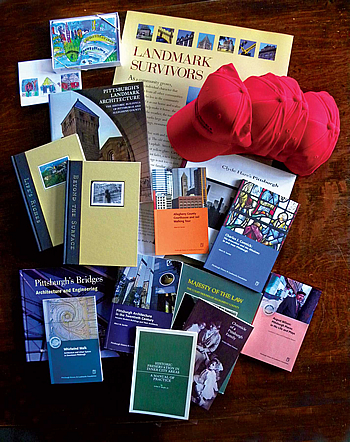
Landmarks Store
| Become a member of Landmarks and receive a 10% discount on any of the following items. Most of the items can be purchased directly from Landmarks by calling @ 412-471-5808, ext 525; or, email frank@phlf.org. | ||||||||||
| Hardcover Books – Softcover Books – Posters – Softbound Booklets – Out-of-Print Books (Library Only) | ||||||||||
Guide Books |
||||||||||
Whirlwind Walk: Architecture and Urban Spaces in Downtown Pittsburgh
![]() Second edition now available. Pittsburgh History & Landmarks Foundation, 2008 ; 2011 A terrific guide, indispensable for first-time visitors and long-time residents alike. What a pleasure it is, to see more of what’s right in front of us and to know more about what we see. Whirlwind Walk delivers Pittsburgh. ––Holly Brubach, author, screenwriter, and design consultant Updated and expanded due to popular demand, Whirlwind Walk is the first fully-illustrated comprehensive walking tour guidebook to many of the principal buildings and public spaces in downtown Pittsburgh. The tour begins at H. H. Richardson’s Allegheny County Courthouse and Jail and ends at Point State Park—the confluence of the Allegheny, Monongahela, and Ohio rivers and the 18th-century Gateway to the West. The clearly marked tour route features 46 entries describing 84 places. The book also includes brief essays on the architectural significance and character of the region, a list of “Downtown Museums and More,” and a new section on “What’s Green Downtown?” First published in conjunction with Pittsburgh’s 250th Anniversary, Whirlwind Walk originated in tours prepared for the National Trust for Historic Preservation in 2006 and for the Society of Architectural Historians in 2007. It is one in a series of self-guided tour booklets that began with the Allegheny County Courthouse and Jail Walking Tour (2007). The first and second editions of Whirlwind Walk were supported by generous contributions from the Carl Wood Brown Fund at the Pittsburgh History & Landmarks Foundation.
|
||||||||||
August Wilson: Pittsburgh Places in His Life and Plays
![]() Laurence A. Glasco and Christopher Rawson Pittsburgh History & Landmarks Foundation, 2011 August Wilson is one of America’s great playwrights. He lived in Pittsburgh from his birth in 1945 to 1978, when he moved to St. Paul, MN, and later to Seattle, WA. He died in 2005 and is buried in Pittsburgh. Wilson composed 10 plays chronicling the African American experience in each decade of the twentieth century––and he set nine of those plays in Pittsburgh’s Hill District. He turned the history of a place into great theater. His plays, including Fences, The Piano Lesson, Two Trains Running, Jitney, Gem of the Ocean, and Radio Golf have become classics of the American stage. August Wilson: Pittsburgh Places in His Life and Plays guides visitors to key sites in the playwright’s life and work in the Hill District and beyond. This guidebook enriches the understanding of those who have seen or read his plays, inspires others to do so, and educates all to the importance of respecting, caring for, and preserving the Pittsburgh places that shaped, challenged, and nurtured August Wilson’s rich, creative legacy. The guidebook research, writing, design, and printing was supported by a Preserve America grant from the National Park Service, administered under the Preserving African American Heritage in Pennsylvania program of the Pennsylvania Historical and Museum Commission. BNY Mellon Foundation of Southwestern Pennsylvania and the Multicultural Arts Initiative were among the lead donors, along with 75 PHLF members and friends.
Contents include:
Book specifications:
|
||||||||||
Charles J. Connick: His Education and His Windows in and near Pittsburgh
![]() Albert M. Tannler Pittsburgh History & Landmarks Foundation, 2008 When Charles Connick (1875-1945) died, The New York Times reported that he was “considered the world’s greatest contemporary craftsman in stained glass.” Connick spent 22 of his first 32 years living in Pittsburgh, and it was here that he learned and first practiced the art and craft of stained glass window design and fabrication. In 1909 he settled permanently in the Boston area, living and working there until his death. Drawing upon archival and published materials in Pittsburgh, Boston, New York, and Washington, D.C., the book explores in depth Connick’s years of apprenticeship, and documents windows Connick designed and made between 1911 and 1941 in ten landmark buildings in southwestern Pennsylvania. Previously unpublished photographs of Connick and his early work, as well as new information concerning his career and craft, are included.
|
||||||||||
![]() Allegheny County Courthouse and Jail Walking Tour Albert M. Tannler Pittsburgh History & Landmarks Foundation, 2007 Here is a compact, illustrated architectural history of H. H. Richardson’s Allegheny County Courthouse and Jail, the most significant of Pittsburgh’s great buildings. The book is organized as a walking tour around the exterior and within the public areas of both the Courthouse and the former jail. A map, three diagrams, and a bibliography facilitate the journey, which can be either pedestrian or virtual.
|
||||||||||
Hardcover Books |
||||||||||
| The Buildings of Pennsylvania: Pittsburgh and Western Pennsylvania
Lu Donnelly, H. David Brumble IV, and Franklin Toker University of Virginia Press, 2010 ![]() Buildings of Pennsylvania: Pittsburgh and Western Pennsylvania considers the architecture, landscape, and town plans of thirty-one counties. The first comprehensive look at the built environment in this large and varied territory, the volume spans the years from the late eighteenth century through to the first decade of the new millennium. Some 400 illustrations, including photographs, maps, and drawings, bring the nearly 800 entries to life. A volume in the Buildings of the United States series of the Society of Architectural Historians.
|
||||||||||
| Pittsburgh’s Landmark Architecture: The Historic Buildings of Pittsburgh and Allegheny County
Walter C. Kidney Pittsburgh History & Landmarks Foundation, 1997 ![]() This is the most comprehensive account of the historic architecture of Pittsburgh and its county published to date. Pittsburgh’s Landmark Architecture has two main sections: a handsomely illustrated essay on the architectural history of Allegheny County and a guide to 645 pre-1950 landmarks worthy of preservation. A bibliography and maps are included.
|
||||||||||
| Pittsburgh’s Bridges: Architecture and Engineering
Walter C. Kidney Pittsburgh History & Landmarks Foundation, 1999 ![]() This authoritative book on Pittsburgh’s most historic and architecturally impressive bridges reveals much about bridge construction and design. The essay and guide to 50 landmark bridges are handsomely illustrated. Archival photos show construction in progress, and in some cases, demolition. An album of memorable images by noted photographer Clyde Hare documents Pittsburgh bridges from 1950 to the present.
|
||||||||||
| Henry Hornbostel: An Architect’s Master Touch
Walter C. Kidney Pittsburgh History & Landmarks Foundation, 2002 ![]() “Hornbostel’s mind,” a critic wrote, “is at once daring and inventive, and he never hesitates about executing work because it has no precedent. He leads the way where others follow…” This 1909 critique celebrated Henry Hornbostel’s use of iron, steel, and tile on buildings in Pittsburgh and on bridges in New York City. Henry Hornbostel: An Architect’s Master Touch is the first book about this 20th-century American architectural master. Hornbostel designed more than 225 buildings, bridges, and monuments nationwide, in cities such as Albany and New York, New York; Hartford, Connecticut; Atlanta, Georgia; Evanston, Illinois; Cedar Rapids, Iowa; and Oakland and Santa Barbara, California. His brilliance, however, is especially evident in Pittsburgh, Pennsylvania. A lavishly illustrated overview of Hornbostel’s work throughout the United States is followed by a detailed exploration of some 50 projects in Pittsburgh. A “List of Works,” a map of Pittsburgh sites, and a bibliography are included.
|
||||||||||
| Life’s Riches: Excerpts on the Pittsburgh Region and Historic Preservation from the Writings of Walter C. Kidney
Walter C. Kidney Pittsburgh History & Landmarks Foundation, 2006 ![]() The excerpts that compose Life’s Riches come from ten books by Walter C. Kidney, architectural historian of the Pittsburgh History Landmarks Foundation from the 1980s until December 2005. They were compiled for a reading of the late author’s works on January 24, 2006, at the Soldiers’ and Sailors’ National Military Museum and Memorial in Pittsburgh, Pennsylvania. Walter C. Kidney was an architectural historian with a keen eye for the details and design nuances that make building-watching so enjoyable. He was also a writer of rare skill, an articulate raconteur who could blend fact with philosophy and turn prose into poetry. Those gifts are spotlighted in this jewel-like book, comprising excerpts from ten of the author’s works. While he writes specifically about Pittsburgh, a city that he knew intimately and loved deeply, Kidney’s words have a near-universal applicability.
|
||||||||||
| Beyond the Surface: Architecture and Being Alive
Walter C. Kidney
For just over a decade Walter C. Kidney, architectural historian and author for the Pittsburgh History & Landmarks Foundation from the early 1980s until his death on December 1, 2005, thought about, composed, re-worked, refined, and simplified the words that now form Beyond the Surface: Architecture and Being Alive. Walter describes the book as “a little autobiography, with some relevance: how a young Pittsburgher discovered his world, stayed in a very different city, and dealt in time with a crisis of cultural conscience.” Eighteen choice photographs are reproduced as duo-tones; most were taken by the author in the 1940s with his Argus camera. A select bibliography of the author’s publications is also included, compiled by architect David J. Vater.
|
||||||||||
| Allegheny Cemetery: A Romantic Landscape in Pittsburgh
Walter C. Kidney Pittsburgh History & Landmarks Foundation, 1990 This publication is a tribute to Allegheny Cemetery, one of the most picturesque places in Pittsburgh, where Pittsburgh history curiously comes alive. Founded in 1844, Allegheny Cemetery is an unexpectedly romantic place. The Cemetery was laid out by John Chislett, Pittsburgh’s first professional architect and subsequently directed by prominent American landscape architect William Falconer. Many famous Pittsburghers are buried there: those who had local wealth and power and those nationally known, such as Stephen Collins Foster and Lillian Russell. The book includes an essay describing the Cemetery’s history, architecture, and landscape, and a guide to 195 significant burial places and buildings.
|
||||||||||
| Majesty of the Law: The Court Houses of Allegheny County
James D. Van Trump Pittsburgh History & Landmarks Foundation, 1988 This account places the three successive court houses of Pittsburgh in their historical context. The greater part of the text relates the history of H. H. Richardson’s Court House of 1888 and its adjoining Jail, two of the United States’ most illustrious buildings. Their conception, construction, and later history are related in detail, and their composition and place in architectural history are analyzed, with the help of historic and modern illustrations.
|
||||||||||
| Architecture after Richardson: Regionalism before Modernism; Longfellow, Alden, and Harlow in Boston and Pittsburgh
Margaret Henderson Floyd Published by The University of Chicago Press in association with the Pittsburgh History & Landmarks Foundation, 1994 The first critical study of the work of Longfellow, Alden & Harlow (1886-1896) and the successor offices Alden & Harlow (1896-1929) and A. W. Longfellow, Jr. (1896-1923) explores the work of three architects, educated at MIT and apprenticed to H. H. Richardson (Alden/Longfellow) and McKim, Mead & White (Harlow). Together they designed major public, commercial, ecclesiastical, and residential buildings in the Boston and Pittsburgh areas and significantly shaped the visual characters of both cities. Recipient of a 1995 A.I.A. International Book Award
Only available through the University of Chicago. |
||||||||||
| Pittsburgh Legends and Visions: An Illustrated History
Eliza Smith Brown Published by Heritage Media Corporation, in cooperation with the Pittsburgh History & Landmarks Foundation, 2002 Pittsburgh Legends and Visions is an overview of Pittsburgh’s history from its 18th-century founding as a military outpost and “Gateway to the West,” through its transformation into “The Forge of the Universe,” and on to its maturity as an industrial and then post-industrial metropolis. The city’s legends speak to human ingenuity. Throughout each epoch of its development, Pittsburgh has attracted many of the nation’s most talented and ambitious individuals who saw, and seized, opportunity at the Point. These visionaries tamed and exploited the land and its resources, crafted civic improvements, created a rich cultural life and fueled a flexible and robust economy. The book is enhanced by the addition of profiles of Pittsburgh businesses and institutions.
|
||||||||||
| Keep Tryst: The Walkers of Pittsburgh & The Sewickley Valley: An Intimate Portrait of a Prominent Pittsburgh Family Stephen Neal Dennis
As their fortunes grew, Pittsburgh’s prominent Walker family maintained an existing family partnership which manufactured soaps and toilet products, and expanded by investing into a widening circle of new business ventures. Eventually, they dominated the US market for fire bricks used for lining blast furnaces through Harbison-Walker Refractories Company. Other major investments were in banking, an iron foundry, wireless and radio technology, oleomargarine and fertilizer manufacturing, stove and water heater manufacturing, and distilling. The Walkers also played a major role in developing conservation strategies for the important historic landscape of the Sewickley Valley.
|
||||||||||
Softcover Books |
||||||||||
| Clyde Hare’s Pittsburgh: Four Decades of Pittsburgh, Frozen in Light
Photographs by Clyde Hare, Text by Alan Van Dine Pittsburgh History & Landmarks Foundation, 1994 Twentieth century Pittsburgh–from the 1950′s to 1994–comes to life in this collection of compelling images by master photographer Clyde Hare. 165 color and b/w photos reveal Pittsburgh’s revitalization during Renaissance I, the heroics of steel-making, the beauty and grandeur of the landscape, and the variety and richness of everyday life through a period of dramatic change. Alan Van Dine’s introduction elucidates Clyde Hare’s career and his important role in the development of documentary photography. Concise information on each photograph is contained in a “Photographic Notes” section prepared by Walter C. Kidney. Recipient of a 1995 Certificate of Design Excellence from “Print,” America’s graphic design magazine.
|
||||||||||
| Life’s Riches: Excerpts on the Pittsburgh Region and Historic Preservation from the Writings of Walter C. Kidney
Walter C. Kidney Pittsburgh History & Landmarks Foundation, 2006 ![]() The excerpts that compose Life’s Riches come from ten books by Walter C. Kidney, architectural historian of the Pittsburgh History Landmarks Foundation from the 1980s until December 2005. They were compiled for a reading of the late author’s works on January 24, 2006, at the Soldiers’ and Sailors’ National Military Museum and Memorial in Pittsburgh, Pennsylvania. Walter C. Kidney was an architectural historian with a keen eye for the details and design nuances that make building-watching so enjoyable. He was also a writer of rare skill, an articulate raconteur who could blend fact with philosophy and turn prose into poetry. Those gifts are spotlighted in this jewel-like book, comprising excerpts from ten of the author’s works. While he writes specifically about Pittsburgh, a city that he knew intimately and loved deeply, Kidney’s words have a near-universal applicability.
|
||||||||||
| A Patrician of Ideas: A Biography of A. W. Schmidt
Clarke M. Thomas Pittsburgh History & Landmarks Foundation, 2006 Meticulously researched and fascinating to read, A Patrician of Ideas chronicles the remarkable life of McKeesport native Adolph W. Schmidt (1904-2000). A notable American who lived during a time of great American world influence, Schmidt was a U.S. Ambassador to Canada and a vital part of Pittsburgh’s urban renewal history through his management of the A. W. Mellon Educational and Charitable Trust. Published with support from the Laurel Foundation, with a foreword by Landmarks president Arthur Ziegler.
|
||||||||||
Chronicle of a Pittsburgh Family
Evelyn Bitner Pearson Pittsburgh History & Landmarks Foundation, 1999 In a “charming, insightful memoir,” Evelyn Bitner Pearson turns “family history into magic.” Born in 1910 and the daughter of a newspaper editor and publisher, Evelyn recalls the details of a now-disappearing past through the experiences of her family, living in Pittsburgh and elsewhere. Hers is a “bittersweet memoir…that transcends the ordinary.”
|
||||||||||
A Legacy in Bricks and Mortar: African-American Landmarks in Allegheny County
Text by Frank E. Bolden, Lawrence A. Glasco, and Eliza Smith Brown Pittsburgh History & Landmarks Foundation, 1995 A Legacy in Bricks and Mortar tells the story of African-Americans in Allegheny County from the mid 1700s to the present day and shows 62 surviving buildings and places where black citizens have lived, studied, played, worked, and worshiped. Recipient of a “Best of Category” award, presented at the 30th Annual Exhibition of Western Pennsylvania Printing.
|
||||||||||
Historic Preservation in Inner City Areas: A Manual of Practice
Arthur P. Ziegler, Jr. Ober Park Associates, Inc., 1974 This manual, based on the experience of PHLF co-founder and President Arthur Ziegler, provides practical guidance in restoring deteriorating, architecturally-significant inner-city neighborhoods with minimal dislocation of current residents.
|
||||||||||
Revolving Funds for Historic Preservation: A Manual of Practice
Arthur P. Ziegler, Jr., Leopold Adler II, Walter C. Kidney Ober Park Associates, Inc., 1975 This book describes the establishment, management, and use of revolving pools of capital by historic preservation organizations. It reviews the mechanics and results of all major revolving funds in use, including those of Historic Charleston, Historic Savannah, and the Pittsburgh History & Landmarks Foundation.
|
||||||||||
Working Places: The Adaptive Use of Industrial Buildings
Walter C. Kidney The Society for Industrial Archeology and Ober Park Associates, Inc., 1976 This handbook of case studies, plans, and costs is a definitive study of the work of profit and non-profit developers who have found new uses for industrial buildings. “[F]or the potential investor, who in the best sense is also a preservationist, industrial buildings frequently offer easily subdivided interior space, housed within durable construction that yields higher quality and less expensive space than could be obtained in a new building of comparable size.” The idea for the book originated with the Society of Industrial Archeology’s preservation committee in 1972.
|
||||||||||
Historic Buildings of Ohio
Walter C. Kidney Ober Park Associates, 1972 This compendium of the building history of Ohio includes an introductory essay; descriptive essays on 71 buildings, bridges, and monuments; and selected measured drawings from the Historic American Buildings Survey.
|
||||||||||
Posters |
||||||||||
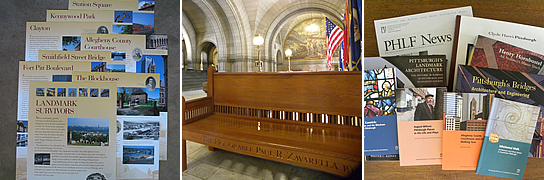
| Landmark Survivors Poster Series
Made possible with funding by Columbia Gas of Pennsylvania.
|
||||||||||
Soft-Bound Booklets |
||||||||||
![]() Excerpts Regarding Preservation in Pittsburgh from Changing Places: Rebuilding Community in the Age of Sprawl Richard Moe and Carter Wilkie Pittsburgh History & Landmarks Foundation, 1999 Landmarks has reprinted, with permission, a portion of Chapter 4, “New Tools for Older Neighborhoods.” The chapter focuses on Pittsburgh and the urban renewal policies of the 1960s that led to the formation of the Pittsburgh History & Landmarks Foundation. This is an excellent summary of Landmarks’ work and includes mention of the Revolving Loan Fund, inner-city revitalization (particularly in Manchester), Pittsburgh Community Reinvestment Group, and Station Square.
|
||||||||||
A List of Pittsburgh and Allegheny County Buildings and Architects 1950-2005
Albert M. Tannler Pittsburgh History & Landmarks Foundation, 2005 This the third edition of an annotated directory of over 100 selected buildings/structures designed by over 40 architectural firms and erected in Pittsburgh and Allegheny County since 1950. Principal late-20th-century buildings in neighboring counties are also listed. There is a bibliography and indices to buildings and to architects.
|
||||||||||
William Willet in Pittsburgh 1897-1913
Albert M. Tannler Pittsburgh History & Landmarks Foundation, 2005 A compendium of designs, projects, sites, and publications documenting the Pittsburgh career of stained glass artist William Willet and his wife Anne Lee Willet. One of two appendices contains correspondence and memoranda between and about Ralph Adams Cram and William Willet and the Seven Liberal Arts window at Procter Hall, Princeton University.
|
||||||||||
The Stones of Pittsburgh No. 1: An Architectural Tour of Pittsburgh
James D. Van Trump Pittsburgh History & Landmarks Foundation, circa 1967 A brief guide to the most significant buildings of Pittsburgh and its suburbs.
|
||||||||||
The Stones of Pittsburgh No. 3: Legend in Modern Gothic: The Union Trust Building in Pittsburgh
Pittsburgh History & Landmarks Foundation, 1967 The Union Arcade, later the Union Trust Building, is spectacular inside and out. This is its history. Recipient of Art Director’s Society Award of Merit
|
||||||||||
The Stones of Pittsburgh No. 4: Evergreen Hamlet
James D. Van Trump A description of four Picturesque “cottages” in one of America’s first suburbs.
|
||||||||||
The Stones of Pittsburgh No. 7: Birmingham: Pittsburgh’s South Side
Arthur P. Ziegler, Jr. Pittsburgh History & Landmarks Foundation, 1968 A history of the South Side neighborhood and a description of Landmarks’ community restoration program in the area. Photographs illustrate the dramatic topography, architecture, religious institutions, and ethnic makeup of the neighborhood.
|
||||||||||
The Stones of Pittsburgh No. 9: A City’s Living Memory
Robert Cairns Pittsburgh History & Landmarks Foundation, no date A review of Landmarks’ work, originally published in the Gulf Oil Corporation publication, The Orange Disc.
|
||||||||||
The Stones of Pittsburgh No. 10: The Gothic Revived in Pittsburgh: A Medievalistic Excursion
James D. Van Trump Pittsburgh History & Landmarks Foundation, 1975 For a hundred years the pointed arch was a favorite motif in Pittsburgh churches, schools, and homes. The author touches on the prominent examples of Gothic in the city, illustrating his essay with drawings by Stephen A. Wohleber and photographs. Reprinted essay from Carnegie Magazine.
|
||||||||||
The Stones of Pittsburgh No. 12: “Our Eastern Domes, Fantastic, Bright…”
James D. Van Trump Pittsburgh History & Landmarks Foundation, no date A brief review of some Orthodox and Byzantine Rite churches in Allegheny County, with drawings by Stephen A. Wohleber. Reprinted essay from Carnegie Magazine.
|
||||||||||
| The Bells of Pittsburgh
James D. Van Trump Pittsburgh History & Landmarks Foundation, 1980 Sacred and secular bells in Pittsburgh-area history are cited in this personal essay.
|
||||||||||
An Ethnic Church Sampler
Arcadi Nebolsine Pittsburgh History & Landmarks Foundation, circa 1978 Fourteen historic religious properties in the Pittsburgh region are featured in this booklet, including Immaculate Heart of Mary (Polish Hill); St. John the Baptist Ukrainian Catholic Church (South Side); St. Nicholas Croatian Catholic Church (Millvale); Rodef Shalom Temple (Shadyside); St. Anthony’s Chapel (Troy Hill); and Sri Venkateswara Temple (Penn Hills).
|
||||||||||
The Walker-Ewing Log House, Built c. 1790: A Short History
James D. Van Trump Pittsburgh History & Landmarks Foundation, 1974 A history of one of the few remaining log houses in Allegheny County
|
||||||||||
Streetcars in Literature
Edited by Harold M. Englund Pittsburgh History & Landmarks Foundation, 1980 Early in this century, characters in realistic fiction were apt to ride the trolley. Here are 16 streetcar episodes from diverse authors such as Sinclair Lewis, Theodore Dreiser, Jack London, and Ellery Queen.
|
||||||||||
The Papercraft Story: A Biographical Saga of a Pittsburgh-based Enterprise
Frances C. Hardie Pittsburgh History & Landmarks Foundation, 1987 An oral history of a Pittsburgh paper products firm, established during the Depression.
|
||||||||||
| Pittsburgh Treasure Hunt
Text and Illustrations by Patricia Wiley Pittsburgh History & Landmarks Foundation, 1976 This book is designed for children, but is also useful for anyone interested in learning about architectural styles. Easy to read and clearly illustrated with charming line drawings, Pittsburgh Treasure Hunt helps children notice and identify details and figure out the architectural style of their house.
|
||||||||||
Print This Page


“Here is the essence of Kidney’s thinking about place and about architecture,” writes fine arts consultant Thomas H. Garver in his introduction. Walter reminds “us that ‘place,’ no matter where that might be, is a visceral, sensory experience first, long before it may change in our minds to one of memory or intellect.”


Chronicle of a Pittsburgh Family
A Legacy in Bricks and Mortar: African-American Landmarks in Allegheny County
Historic Preservation in Inner City Areas: A Manual of Practice
Revolving Funds for Historic Preservation: A Manual of Practice
Working Places: The Adaptive Use of Industrial Buildings
Historic Buildings of Ohio
Discover more about the historic buildings, parks, bridges, and memorable places that give Pittsburgh its special character. Handsomely designed and printed, the posters are wonderful gifts for family, friends, or clients.
A List of Pittsburgh and Allegheny County Buildings and Architects 1950-2005
William Willet in Pittsburgh 1897-1913
The Stones of Pittsburgh No. 1: An Architectural Tour of Pittsburgh
The Stones of Pittsburgh No. 3: Legend in Modern Gothic: The Union Trust Building in Pittsburgh
The Stones of Pittsburgh No. 4: Evergreen Hamlet
The Stones of Pittsburgh No. 7: Birmingham: Pittsburgh’s South Side
The Stones of Pittsburgh No. 9: A City’s Living Memory
The Stones of Pittsburgh No. 10: The Gothic Revived in Pittsburgh: A Medievalistic Excursion
The Stones of Pittsburgh No. 12: “Our Eastern Domes, Fantastic, Bright…”

An Ethnic Church Sampler
The Walker-Ewing Log House, Built c. 1790: A Short History
Streetcars in Literature
The Papercraft Story: A Biographical Saga of a Pittsburgh-based Enterprise